
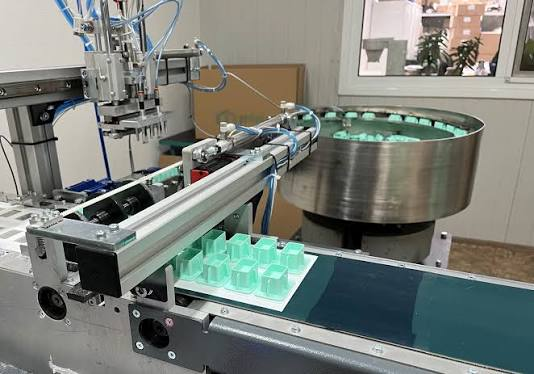
Modern manufacturing is constantly evolving as businesses seek faster production, better quality, and lower operating costs. One of the most effective technologies helping Automated Assembly Machine manufacturers achieve these goals is the Automated Assembly Machine. By combining advanced robotics, sensors, control systems, and precision engineering, automated assembly equipment can perform repetitive production tasks with impressive speed and consistency. From automotive components and electronics to medical devices and consumer products, automated assembly systems are becoming an essential part of modern manufacturing.
What Is an Automated Assembly Machine?
An Automated Assembly Machine is a specialized production system designed to automatically combine individual components into a finished product or subassembly. Unlike traditional manual assembly, where workers perform most tasks by hand, automated systems use mechanical mechanisms, robotic arms, sensors, conveyors, and programmable controls to complete assembly operations.
Depending on the application, an automated assembly system can perform tasks such as feeding components, positioning parts, fastening screws, pressing components together, welding, riveting, dispensing adhesives, testing products, and packaging finished assemblies. These machines can be customized according to product design, production volume, and manufacturing requirements.
Improving Manufacturing Efficiency
Manufacturing efficiency is one of the most important advantages of automation. Manual assembly can require significant amounts of time, particularly when workers need to repeat the same operation hundreds or thousands of times. An Automated Assembly Machine can perform repetitive processes continuously while maintaining a consistent operating speed.
Automated systems can also reduce unnecessary movement between production stages. Components can be transported automatically from one workstation to another through conveyors, robotic transfer systems, or integrated feeding mechanisms. This streamlined workflow helps minimize production delays and allows manufacturers to achieve higher output within the same production environment.
Another major benefit is improved machine utilization. Automated equipment can operate for extended production periods with limited interruption, helping manufacturers meet demanding production schedules and respond to large orders more efficiently.
Enhancing Precision and Product Quality
Precision is critical in industries where even small assembly errors can affect product performance. Human workers can experience fatigue, distraction, or inconsistency during repetitive tasks. Automation helps address these challenges by performing operations according to programmed instructions.
An Automated Assembly Machine can position components accurately and apply controlled pressure, torque, or adhesive quantities. Advanced sensors and vision systems can inspect parts before and during assembly, helping identify incorrectly positioned, damaged, or missing components.
Quality control can also be integrated directly into automated production lines. For example, a machine may automatically measure dimensions, verify component placement, check fastening conditions, or test product functionality. Products that fail predefined quality standards can be separated from acceptable units, reducing the chances of defective products reaching customers.
Increasing Productivity
Productivity is another major reason manufacturers invest in automated assembly technology. When machines handle repetitive operations, employees can focus on tasks that require problem-solving, supervision, maintenance, quality analysis, and process improvement.
Automated equipment can also maintain consistent cycle times. Once properly configured, the system can perform the same operation repeatedly without the variations commonly associated with manual production. This consistency allows manufacturers to plan production more accurately and improve overall throughput.
In high-volume manufacturing environments, even a small reduction in cycle time can create significant productivity gains. Over thousands of production cycles, faster and more consistent operations can result in substantially higher output.
Reducing Production Costs
Although purchasing an Automated Assembly Machine can require a significant initial investment, automation can provide long-term cost advantages. Reduced dependence on manual labor for repetitive tasks can lower certain operating expenses while improving production capacity.
Automation can also help reduce material waste. Precise dispensing, cutting, fastening, and component placement can minimize errors that result in rejected products or wasted materials. Better quality control further reduces costs associated with rework, returns, and warranty claims.
Manufacturers should evaluate the total cost of ownership when considering automation. Factors such as machine maintenance, energy consumption, programming, training, spare parts, and expected production volume should all be considered before selecting a system.
Applications Across Different Industries
Automated assembly technology is used across a wide range of industries. In the automotive sector, automated systems can assemble components such as electrical modules, interior parts, sensors, and mechanical assemblies. Electronics manufacturers use automation for tasks involving circuit boards, connectors, switches, and small precision components.
Medical device manufacturers can use automated assembly equipment to achieve the accuracy and repeatability required for sensitive products. Consumer goods companies can automate the assembly of appliances, household products, toys, and personal devices.
Industrial equipment manufacturers can also benefit from automated systems when producing standardized components at high volumes. The flexibility of modern automation makes it possible to design systems for both simple and complex assembly requirements.
Smart Features and Advanced Automation
Modern Automated Assembly Machine technology is increasingly connected to smart manufacturing systems. Industrial sensors can collect information about production performance, machine conditions, and quality results. This data can help manufacturers identify problems and improve processes.
Machine vision is another important technology. Cameras and intelligent inspection systems can recognize components, verify their orientation, detect defects, and confirm correct assembly. Robotics can also provide greater flexibility when handling different components or performing multiple operations.
Programmable logic controllers and industrial software allow manufacturers to modify production sequences and monitor machine performance. These capabilities support more flexible manufacturing and make it easier to adapt production lines when product requirements change.
Improving Workplace Safety
Automation can also contribute to a safer manufacturing environment by taking over repetitive or physically demanding operations. Tasks involving continuous lifting, pressing, fastening, or handling components can place strain on workers when performed manually for long periods.
By assigning appropriate tasks to machines, employees can spend more time supervising equipment, managing quality, and performing skilled operations. Safety systems such as protective guards, sensors, emergency stops, and controlled operating zones can further improve the working environment.
Automation does not eliminate the need for human workers. Instead, it changes the nature of many manufacturing roles and creates opportunities for employees to develop technical skills in machine operation, programming, maintenance, and process management.
Choosing the Right Automated Assembly Machine
Selecting the appropriate automated assembly system requires careful consideration. Manufacturers should evaluate product specifications, production volume, component characteristics, required cycle time, available floor space, and quality standards.
The machine should also be designed with future requirements in mind. A flexible system that can accommodate product variations or production changes may provide greater long-term value than equipment designed for only one fixed application.
Reliable support, maintenance services, spare parts availability, and operator training are also important factors. A well-supported machine can maintain consistent performance and reduce unexpected production downtime.
The Future of Automated Assembly
The future of automated assembly is closely connected to robotics, artificial intelligence, machine vision, data analytics, and smart manufacturing. As these technologies continue to develop, assembly systems are becoming more intelligent, flexible, and capable of making real-time decisions.
Manufacturers are increasingly looking for systems that can automatically detect production issues, optimize processes, monitor equipment health, and communicate with other factory systems. These developments are helping create connected production environments where machines, software, and people work together more efficiently.
Conclusion
An Automated Assembly Machine provides manufacturers with an effective way to improve efficiency, precision, productivity, and product quality. By automating repetitive operations and integrating advanced inspection and control technologies, these systems can help businesses increase output while reducing errors and production waste.
As manufacturing continues to become more competitive, automation will play an increasingly important role in helping companies meet customer expectations and maintain efficient operations. Investing in the right automated assembly solution can provide long-term benefits by creating a faster, more consistent, flexible, and reliable manufacturing process.