A shopper searches “best running shoes for flat feet.” Instead of clicking through product pages, they read the AI-generated answer. It recommends three brands. Yours is not one of them.
This is happening across every e-commerce category. AI answers are intercepting purchase-intent queries before shoppers ever reach your site.
What Most E-Commerce Teams Get Wrong
E-commerce marketers optimize product pages for Google Shopping and organic rankings. They invest in paid search. They build review profiles. That foundation still matters. But it no longer captures the full picture.
AI tools now answer product research queries directly. “Best wireless earbuds under $100” generates a curated list in ChatGPT. “What moisturizer is best for sensitive skin” produces a recommendation in Perplexity. Google AI Overviews summarize product comparisons at the top of the SERP.
Most e-commerce teams do not track these recommendations. They see organic traffic declining and assume it is a ranking issue. Their rankings are fine. The clicks simply go nowhere because the AI answered first.
The instinct is to spend more on paid search. That works until costs rise because every competitor does the same. Meanwhile, brands appearing in the AI answer get free visibility at the top of the funnel.
E-commerce traffic loss from AI answers is not a ranking problem. It is a citation problem. The brands AI models recommend get the clicks. Everyone else competes for the leftovers.
What E-Commerce AI Visibility Requires
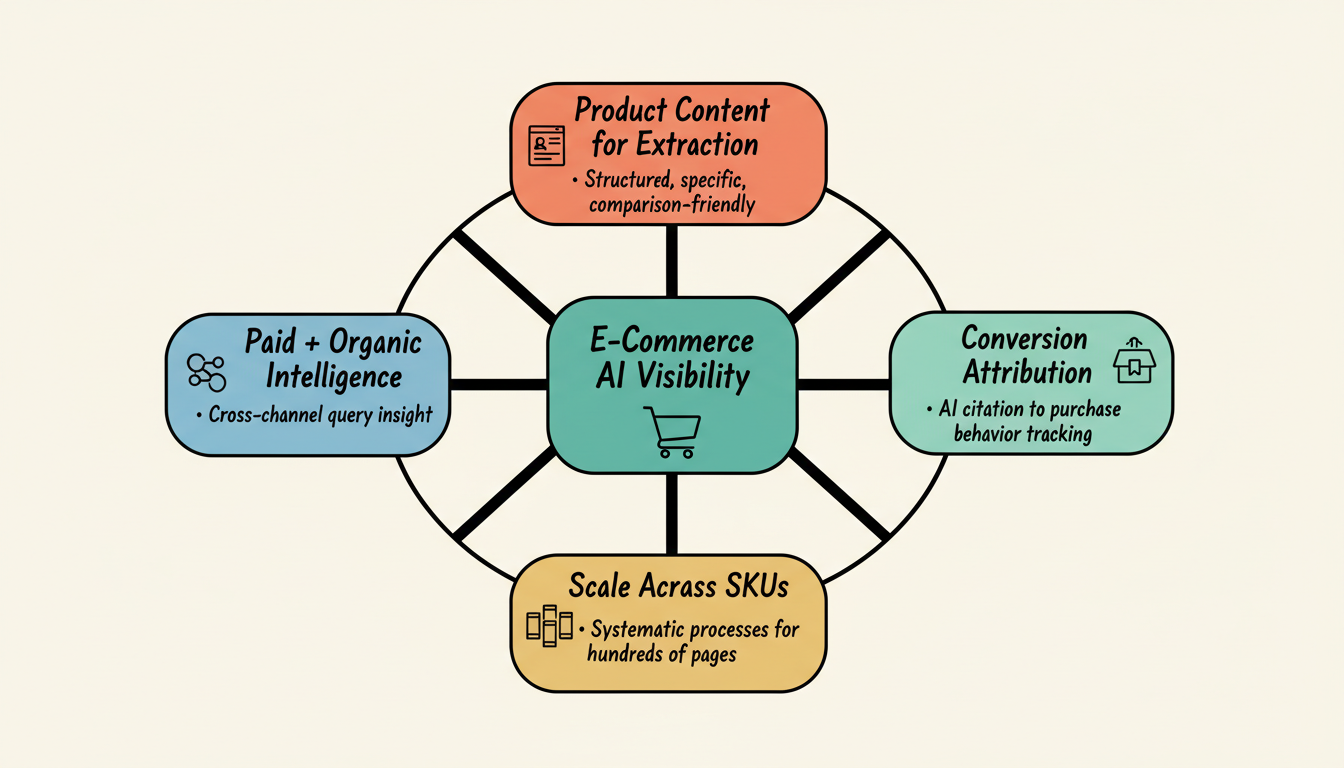
Getting your products cited in AI-generated answers demands a different approach than traditional e-commerce SEO. Here is what separates the brands that appear from those that do not.
Product Content Built for Extraction
AI models pull product recommendations from content that is structured, specific, and authoritative. Generic product descriptions do not get cited. You need detailed, comparison-friendly content that states exactly what your product does, who it serves, and how it compares to alternatives.
Data-Driven Conversion Optimization
AI visibility without conversion is wasted effort. The right partner connects AI citation data to actual purchase behavior. Look for attribution models that track the full path from AI-generated recommendation to checkout, with proven results in conversion improvement.
Speed Across Hundreds of SKUs
E-commerce catalogs are large. Optimizing one product page at a time is too slow. Your strategy needs to scale across hundreds or thousands of pages with systematic, repeatable processes. A partner experienced with high-volume optimization delivers results faster.
Combined Paid and Organic Intelligence
AI answers often appear alongside paid shopping results. Understanding how these channels interact is critical. The best strategies use paid campaign data to identify which product queries AI models answer, then optimize organic content for those specific queries.
A partner experienced in answer engine optimization builds this cross-channel intelligence into your e-commerce strategy from the start.
How to Recapture Traffic From AI Answers
- Audit your AI product visibility. Search your top 20 product category queries in ChatGPT, Perplexity, and Google AI Overviews. Document which brands get recommended. Note the format and structure of the content being cited.
- Create comparison and buyer guide content. AI models heavily cite well-structured comparison pages. Build honest, detailed guides for your key product categories. Include specific product attributes, use cases, and direct recommendations.
- Restructure product pages for AI readability. Add concise product summaries at the top of each page. Use structured headers for features, specifications, and ideal customer profiles. Implement Product, Review, and Offer schema markup.
- Build category authority content. Publish expert guides, how-to content, and educational material around your product categories. AI models assess site-level authority when deciding which sources to cite for product recommendations.
- Track AI citation impact on revenue. Monitor which products appear in AI-generated answers. Measure the revenue impact of those citations versus non-cited products. An answer engine optimization approach ties AI visibility directly to sales metrics so you can quantify the ROI.
The Revenue Impact Is Real and Growing
Every AI-generated answer that recommends a competitor instead of you is a lost sale. Not a lost impression. A lost sale. High-intent queries from shoppers ready to buy.
E-commerce brands investing in AI visibility now are building a recommendation moat. Brands that appear consistently get cited more often, creating a reinforcing cycle competitors cannot break.
The shift is accelerating. More shoppers use AI tools for product research every month. Brands that wait for this trend to “stabilize” will find their competitors have already locked in the recommendations.
None of your catalog strength or review volume matters if AI models do not cite you. The brands that solve this now will capture a disproportionate share of e-commerce revenue ahead. The ones that do not will keep losing traffic they cannot explain.